Intent on making big impacts
Support from NSF Graduate Research Fellowships is motivating these engineering doctoral students to strive for exceptional achievements
Recipients of National Science Foundation Graduate Research Fellowships are seen by the federal agency as potential leaders in research, teaching and innovation in engineering and science.
Career success for these students is viewed as critical to the United States maintaining its leading role in technological advancement and its strength in national security.
The NSF also counts on the students’ future contributions to boost the vitality of the country’s economy.
The Graduate Research Fellows are awarded a three-year annual stipend of $34,000 and a $12,000 cost-of-education allowance for tuition and fees to pursue graduate degrees.
They also have opportunities for internships, professional development and participation in international research projects, and the freedom to do their own research at any accredited U.S. institution of graduate education of their choice.
Three graduate students in Arizona State University’s Ira A. Fulton Schools of Engineering — each pursuing a doctoral degree — are among the 2016 recipients of the highly sought after NSF Fellowships.
See full story here: But below is the story that highlights a student in our research group:
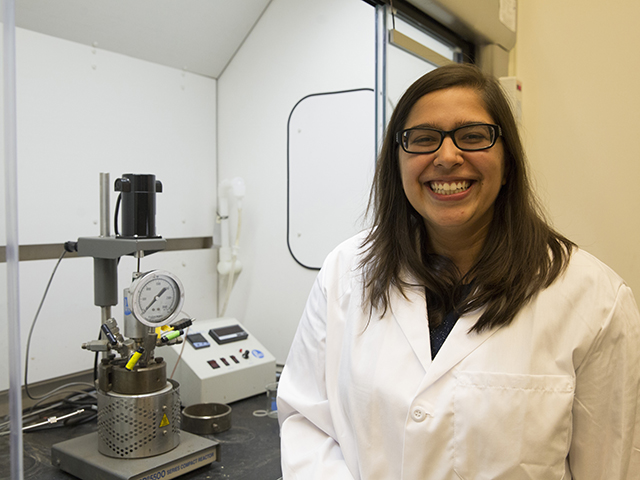
Research, teaching and educational outreach are passions
Anjali Mulchandani graduated from the University of California, Los Angeles, in 2014 with an undergraduate degree in civil and environmental engineering. But one of things that most strongly drew her interest there was a presentation by a visiting ASU engineer.
The talk by Fulton Schools Professor Bruce Rittman, director of the Swette Center for Environmental Biotechnology, put ASU on her list of places to explore when she was ready to apply to graduate school.
On her visit she met other ASU engineering professors whose expertise aligned with her interests in water-related engineering.
Now Fulton Schools Vice Dean of Research and Innovation, Professor Paul Westerhoff, a leading water treatment researcher, is her doctoral studies advisor.
Mulchandani, who grew up in Riverside, California, says she misses the ocean beaches that are close to UCLA, “but I have fallen in love with ASU. The environmental engineering community here is great.”
Her research and studies to earn a doctoral degree in the field focus on developing ways to reduce the amount of waste generated and the amount of energy consumed by current and emerging water treatment systems.
She is getting to pursue that goal by working with the ASU team led by Westerhoff that is part of a National Science Foundation Engineering Research Center, the Nanotechnology Enabled Water Treatment Systems center, or NEWT.
She was the president of NEWT’s Student Leadership Council, heading a group of students from each of the four universities that are part of NEWT. They helped to set the direction of the center’s research agenda and to communicate to the public about the center’s work.
Those students are also forming a network to continue collaborations on research as they complete work toward their degrees and embark on their careers.
A main thrust of Mulchandani’s research is atmospheric water capture, involving “a renewable, reusable system that could collect moisture from the air, and then convert it to a liquid phase for use as drinking water,” she explains. “This kind of system could be deployed to provide water in military, disaster relief, or rural off-grid locations.”
She thought it “a humorous but apt take on my work,” when at a research meeting Professor Westerhoff described her dissertation on getting water from the air and gold from waste material as “finding valuable things in unexpected places.”
Along with research, Mulchandani is putting significant time into gaining more experience in teaching, which she also wants to be a major part of her career.
The K-12 education outreach she’s done so far has led her to “fall in love with teaching, especially with teaching young students, because they are so open to learning and get so excited about it,” she says.
Teaching is a valuable skill for scientists and engineers to learn, she adds, “because one way you truly know that you understand your research and can communicate the importance of it is when you have to explain it to a sixth-grader.”
Mulchandani has worked on a National Science Foundation-supported project with Fulton Schools Assistant Dean of Engineering Education, Associate Professor Tirupalavanam Ganesh, that teaches sixth-grade students about water-related science.
She is currently teaching an after-school program in local elementary schools for which she devised the curriculum and the experiments that her young students conduct to learn basic principles of science and engineering.
She has also recruited her fellow graduate students to participate in ASU’s annual Night of the Open Door event that showcases the university’s research endeavors.
“I’m passionate about teaching and outreach, and that’s one of the reasons I like ASU. It does a good job at fulfilling its role as a public university by trying to communicate about the research it’s doing and how it is going to benefit the public.”
Some of the lessons she teaches young students in her education outreach classes are drawn from the research Mulchandani highlighted in the proposal that earned her the NSF Graduate Research Fellowship: her work on methods to recover gold, other valuable metals and bio-oil from sewage sludge.
With her presentation titled “You flushed the toilet, now what?” she teaches students about wastewater treatment plants, metals that are in foods and personal care products that end up in sewage, how sewage and waste are currently disposed of, and new sewage treatment and resource recovery technologies.
Work in those areas not only provided her a topic for her master’s thesis but won her research presentation competitions and awards at a national Sustainable Nanotechnology Conference, at an AZ Water Association Research Workshop, and at a research symposium for ASU graduate students in civil, environmental and sustainable engineering.
She also won the AZ Water Association’s Young Professionals Fresh Ideas competition for a presentation at the AZ Water Association annual conference earlier this year. The association then sent her to the American Water Works Association Annual Conference and Exposition this past summer in Chicago, where she presented her work to a national audience of water science and engineering experts.
Getting support from an NSF Graduate Research Fellowship award to help her pursue career goals in both research and teaching is a big motivator.
The fellowship “is one of the absolute most prestigious things you can aspire to as a graduate student,” Mulchandani says, and it makes her all the more determined “to do work that solves big problems and really helps people.”
Media Contact
Joe Kullman, [email protected]
480-965-8122
Ira A. Fulton Schools of Engineering