Research

Instrumentation for testing materials and concepts for CO2 Direct Air Capture
To improve DAC efficiency, this project aims to design a bench-scale apparatus that operates sorbent desorption under vacuum and at controlled water vapor flow rates. This setup leverages the exothermic effect of water adsorption under vacuum, enabling a temperature increase in sorbents without additional heat, thus potentially reducing external energy input for CO₂ desorption.
This one-of-a-kind apparatus provides insights into sorbent behaviour by capturing temperature behaviour during water adsorption and CO₂ release in vacuum conditions. By characterizing sorbents under varied CO₂ and H₂O loading states, we can optimize DAC performance and material stability, helping to enhance the scalability of DAC systems. This study provides essential data for the improvement of sorbent materials and operational efficiency in DAC applications.
Mitesh Patil

Separations and treatment platforms for saline and hypersaline water
Sustainable access to potable water continues to worsen in many places around the world, including Arizona. We continue to accelerate toward a scenario in which saline feedstocks will be used to generate industrial and potable water. Therefore, reducing energy barriers and costs associated with desalination is a crucial need in the next decade. To address this challenge, the project focuses on optimizing the membrane separation process with the help of Zwitterion-modified polysulfone membranes, which have exhibited high water permeance, salt rejection, and resistance to biofouling. By performing mechanistic fouling and scaling studies, we will develop an understanding of the interplay between zwitterions, proteins, and silica. By conducting energy analyses to compare the operational costs of using our membranes in reverse osmosis and pervaporation configurations
Saheed Raheem & Ramesh Babu Komma

Emulsion-templated porous polymers for moisture-swing CO2 capture

Carbon dioxide levels now exceed 420 ppm, driving global warming and demanding effective mitigation strategies. This research develops low-cost, high-surface-area porous polymers, specifically polyHIPEs, as scalable sorbents for Direct Air Capture. PolyHIPEs offer tunable pore structures, functionalization (e.g., with amines), and potential integration into additive manufacturing to improve CO2 adsorption efficiency and industrial applicability, addressing the cost and scalability issues of current DAC materials.
Shahanaz, Dr. Medel, Deepak, Dr. Niimoto

Water Management in Direct Air Capture Technologies using First Principles
This project focuses on improving the water and energy efficiency of Direct Air Capture (DAC) systems that use solid sorbents like potassium carbonate-based solid sorbents. While DAC technologies can remove CO₂ directly from ambient air, their performance is often limited by high water use and energy requirements for regeneration. Our work explores how water interacts with these solid sorbents and how managing this interaction can reduce desorption energy while minimizing water loss. By combining laboratory adsorption–desorption experiments with thermodynamic modeling, we aim to establish operating conditions that enable low-enthalpy regeneration and support sustainable water recovery strategies. Ultimately, this study seeks to inform the design of next-generation DAC systems optimized for arid climates, where both carbon capture and water stewardship are critical.
Marcellinus, Dr. Korah

Integration of Atmospheric water harvesting and Direct air carbon capture
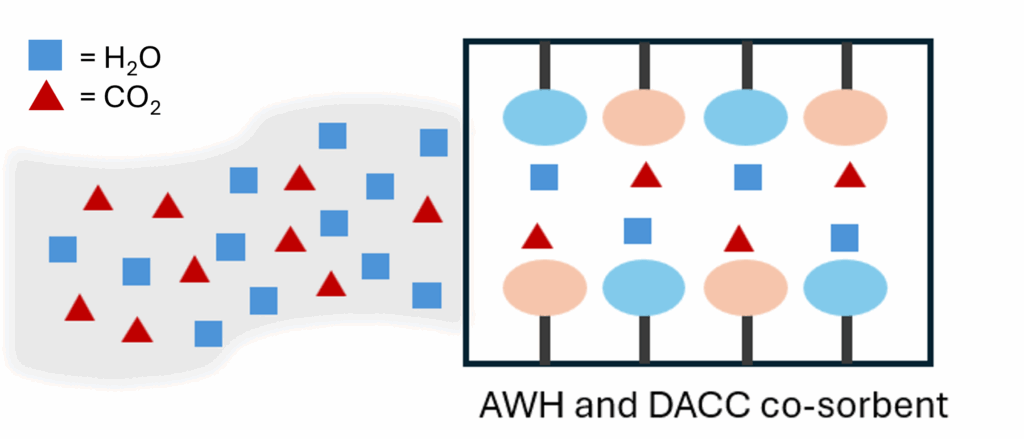
Effectively addressing environmental and resource challenges requires both mitigation and adaptation strategies. Mitigation involves identifying and transitioning away from carbon-intensive technologies, as well as integrating negative emission solutions to compensate for delays in implementation. Simultaneously, adaptation focuses on developing technologies to address existing impacts, such as water scarcity caused by shifting precipitation patterns. This research project aims to operationalize this dual approach by developing a polymer-based sorbent that simultaneously facilitates direct air carbon capture (DACC) and atmospheric water harvesting (AWH), thereby enhancing resource efficiency and environmental resilience.
Anusha

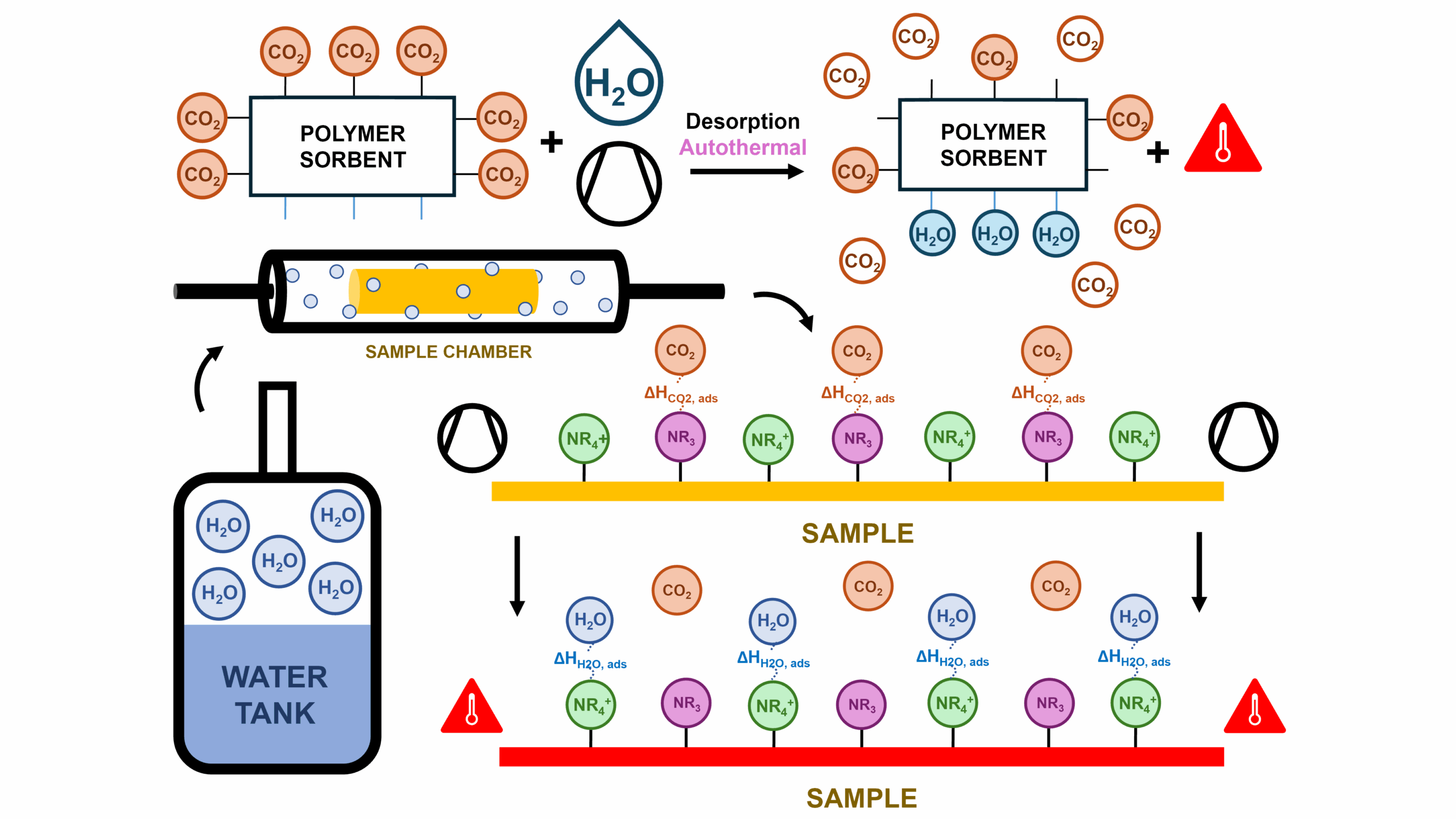
Autothermal Sorbent Synthesis: Two chemistries, one sorbent
Driven by the demand for novel and adaptable sorbents with enhanced capacities and lower regeneration energies, this work focuses on developing hybrid polymers with amine and quaternary ammonium functionalities. These functionalities respond to CO₂ under different humidity and temperature conditions. We hypothesize that the combination of adjacent quaternary ammonium and amine sites will generate excess heats of water adsorption, and this heat could potentially drive the desorption of CO2 from amine-tethered sites without or reducing the need for external energy input for regeneration. This current research focuses on designing copolymers of amines and quaternary ammonium with various counter-ions and investigate the effects of temperature and humidity on the CO2 sorption capacities of these polymers.
Deepak & Dr. Medel

Multifunctional Polymer Nanocomposites with Mechanically Activated Fluorescence
Polymer nanocomposites have numerous applications in various industries, including automotive, aerospace, construction, adhesives, and coatings, due to their excellent adhesion, lightweight, and durability. To tailor the thermal, mechanical, optical, and electrical properties of these networks, nano-additives are incorporated to obtain multifunctional nanocomposites. Understanding the mechanical failure mechanisms of these polymer nanocomposites will enable the design of new high-performance polymers. We systematically vary the polymer matrix chemistry to investigate how it affects nanoparticle dispersion and stimuli-responsive behavior of nanocomposites. This project demonstrates a novel, non-destructive diagnostic technique that utilizes fluorescence activated by the mechanical force for damage detection.
Romina

3D-printed sorbents for direct air capture of carbon dioxide
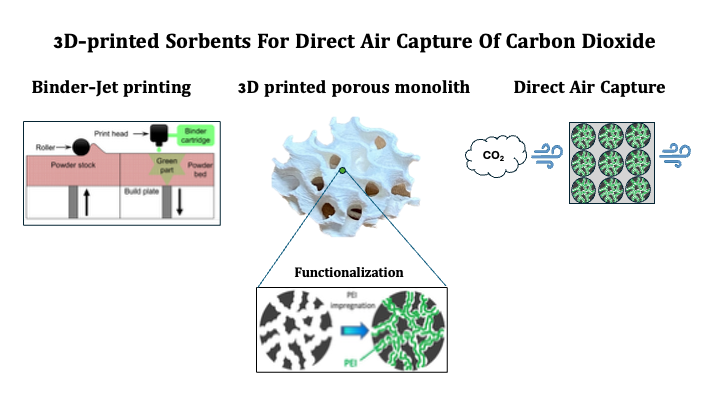
Existing solid sorbents used for direct air capture (DAC) of carbon dioxide (CO2) are often produced as beads, powders, or other forms with limited exposed surface area to volume of sorbent. It is essential to consider the form and macroscopic structure of the sorbent to improve the kinetics and transport properties, which are relevant in scaling up DAC. The application of DAC processes using the current geometric form of sorbent results in a substantial amount of sorbent mass not effectively utilized, leading to sorbents being one of the highest costs in a DAC system.
This project synergistically combines the power of the additive manufacturing method, binder jet printing, with novel polymers to create effective porous structures to overcome the aforementioned challenges. The project focuses on 3D printing mesoporous silica-based monoliths and controlling print parameters to achieve a hierarchy of pores. The porous 3D printed structure is post-functionalized with Polyethyleneimine (PEI) for DAC applications. Through experimental testing for sorption and TEA, a comprehensive comparison will be made between the new 3D-printed sorbents and the existing bead-based sorbents.
Ramesh & Dr. Hamblin

Degradation of Direct Air Capture of CO2 (DAC) sorbent Materials
This research focuses on understanding and improving the stability of quaternary ammonium (QA) methacrylate polymers used for direct air capture (DAC) of CO₂. These materials enable moisture-swing CO₂ capture but are prone to degradation under alkaline conditions. I study the degradation behavior of poly(2-(methacryloyloxy)ethyl trimethylammonium chloride) (PTMAEMA) and its possible degradation pathways, and design QA copolymers incorporating hydrophobic monomers such as butyl acrylate (BA), butyl methacrylate (BMA), methyl methacrylate (MMA), and trifluoroethyl methacrylate (TFEMA) to evaluate their influence on stability and surface hydrophobicity. This work establishes key structure-property relationships that inform the design of more durable and efficient QA-based sorbents for scalable DAC systems.