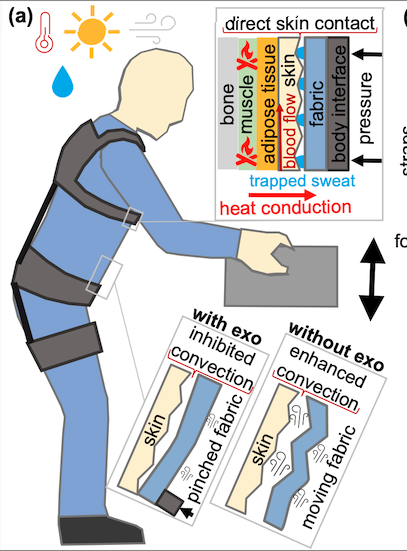

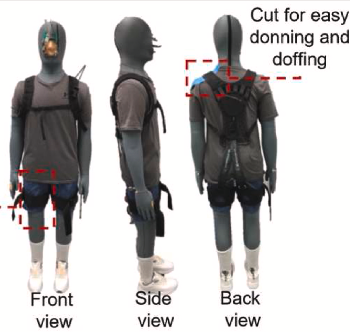
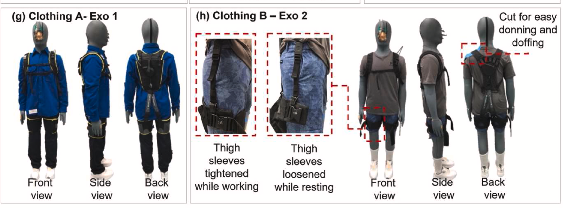
Technological advancements in the last two decades have enabled development of a variety of mechanically supporting wearable robots (i.e. exosuits and exoskeletons) that are transitioning to practice in medical and industrial settings. The feedback from industry and recent controlled studies is highlighting thermal discomfort as a major reason for the disuse of the devices and a substantial barrier to their long-term adoption. Furthermore, a brief overview of the devices and their intended applications reveals that many of the potential users are likely to face thermal comfort issues because of either high exertion or medically related high heat sensitivity. We focus on understanding the underlying thermal physiological mechanisms, developing potential solutions and a thermal manikin based platform for systematically measuring heat transfer inhibition caused by wearing of an exoskeleton. Lastly, we are also exploring the potential to reduce worker thermal strain in warm-to-hot conditions via substantial metabolic rate reduction provided by exosuits.
Relevant publications:
Joshi, A., Bartels, L., Viswanathan, S., Martinez, D., Sadeghi, K., Jaiswal, A. K., Collins, D., and Rykaczewski, K.,*Evaluation of Thermal Properties and Thermoregulatory Impacts of Lower Back Exosuit using Thermal Manikin, International Journal of Industrial Ergonomics, (2023).
Rykaczewski, K.,* Thermophysiological aspects of wearable robotics: Challenges and opportunities (Priority Review), Temperature, (2023).