
We aim to understand all modes of human-surrounding heat & mass exchange across lengths scales, from single sweat pores to whole-body levels. We use analytical modeling, simulations, and developed innovative experimental methods to quantify conduction, radiation, convection, and evaporation dynamics between human skin and its surrounding, with particular emphasis on extremely hot outdoor conditions.
Evaporation of sweat: microscale fundamentals
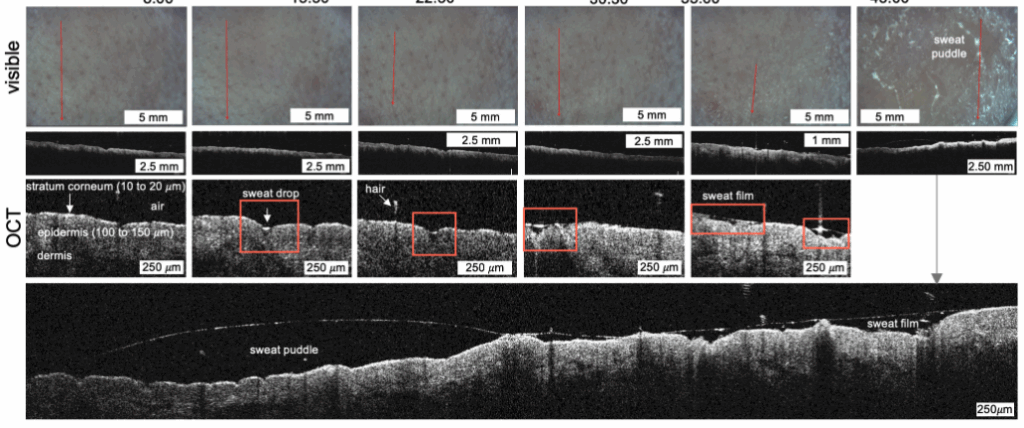
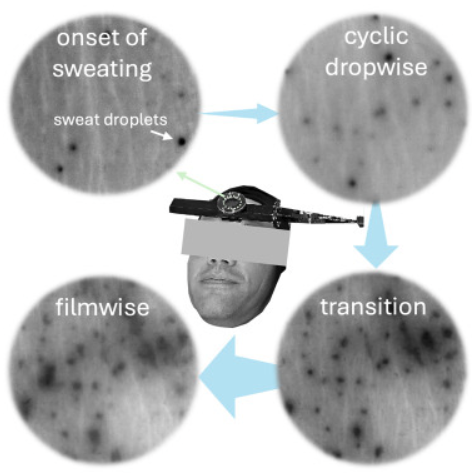
Sweating is important to human thermoregulation, thermal comfort, illness diagnosis, and hygiene product development. However, little is known about how droplets emerge and evaporate from our sweat glands. The scale of these phenomena is in-between molecular processes that drive sweat generation revealed by biochemists and macroscopic sweat rate measurements performed by physiologists. Engineers have studied evaporation across all these length scales but only in non-biological settings. We use three advanced imaging techniques to provide a unique view of droplets during various sweating stages. The “multi-pore level” imaging is integrated with novel wind-tunnel shaped ventilated capsule that allows for sweat rate measurement in realistic flow conditions. To identify the main physical mechanisms underlying sweat evaporation, high-resolution photographs and videos are interpreted with theoretical modeling and additional experimentation with artificial sweating surfaces.
Co-PIs: Stavros Kavouras (ASU)
Funding: National Science Foundation
Representative publications:
Jose, C., Joshi, A.,Viswanathan, S., Nash, S., Sadeghi K., Kavouras, A.S., Rykaczewski, K.* A micro-to-macroscale and multi-method investigation of human sweating dynamics, Journal of the Royal Society Interface, (2025).
Jaiswal, A., Jose, C., Ramesh, R., Nanani, V., Sadeghi, K., Joshi, A., Kompally, K., Pathikonda, G., Emady, N.H., Bheda, B., Kavouras, A.S., Rykaczewski, K.* Simultaneous Imaging of Multi-pore Sweat Dynamics and Evaporation Rate Measurement using Wind Tunnel Ventilated Capsule with Infrared Window, iScience, (2024).
Radiation, convection, and evaporation in extreme heat
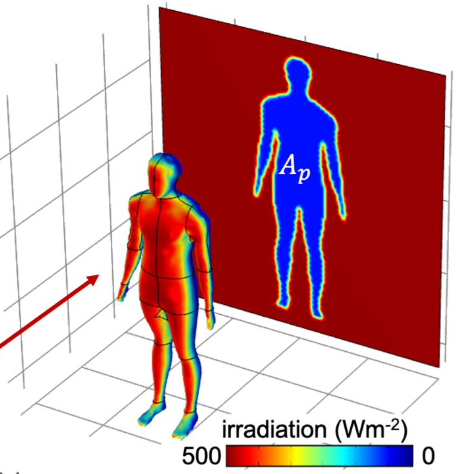
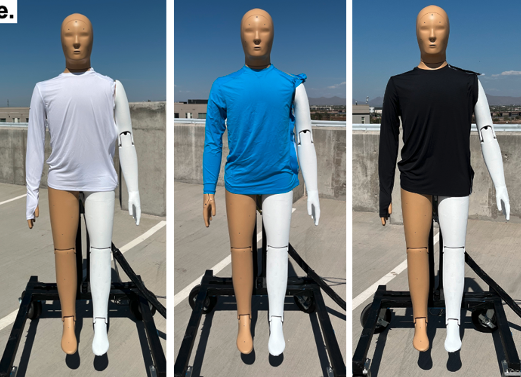
With funding from $2 million NSF Leading Engineering for America’s Prosperity, Health, and Infrastructure (LEAP-HI) program and Major Research Instrumentation, we are leverages expertise from disparate disciplines to pioneer new field methods for measuring indoor and outdoor human heat exposure unprecedented detail. The method merges an advanced mobile biometeorological station with a novel human-shaped thermal manikin ANDI. Physical methods are co-developed with computational manikins to allow a realistic heat exposure assessment across various demographics, body shapes, and scenarios. The aim is to advance these methods so they can be implemented to make informed behavioral, policy, and infrastructure decisions around heat.
With Prof. Jennifer Vanos and Prof. Ariane Middel, we have setup state-of-the art facility for studying human exposure to extreme heat in real and mimicked extreme environments. The facilities include a heat chamber in the Walton Center for Planetary Health with a walk-in wind enclosure, and the custom ANDI thermal manikin sponsored by NSF MRI grant. In outdoor measurements ANDI is paired up with his best friend MaRTy-3D, the biometeorological station. In addition to these unique high ends instrumentation, we use insight from these instruments to develop new affordable, yet accurate, radiation and convection cylindrical sensors “CARla”.
Representative publications:
Joshi, A., Viswanathan, S.H., Jaiswal, A.K., Sadeghi, K., Bartels, L., Jain, R.M., Pathikonda, G., Vanos, J.K., and Middel, A. and Rykaczewski, K.,* Characterization of Human Extreme Heat Exposure Using an Outdoor Thermal Manikin, Science of the Total Environment, (2024)

Sadeghi, K., Viswanathan, S., Joshi, A., Bartels, L., Wereski, S., Jose, C.T., Mihaleva, G., Abdullah, M., Middel, A. and Rykaczewski, K.,* Resolving shortwave and longwave irradiation distributions across the human body in outdoor built environments, Building and Environment, (2025).
Rykaczewski,K.* Joshi, A., Viswanathan, S.H., Guddanti, S.S., Sadeghi, K., Gupta, M., Jaiswal, A.K., Kompally,K., Pathikonda,G., Barlett,R., Vanos, J.K., and Middel, A. A simple three-cylinder radiometer and low-speed anemometer to characterize human extreme heat exposure, International Journal of Biometeorology, (2024).

Viswanathan, S., Joshi, A., Bartels, L., Sadeghi, K., Vanos, J.K., and Rykaczewski, K.,*Impact of Human Body Shape on Free Convection Heat Transfer, PLOS ONE, (2025).

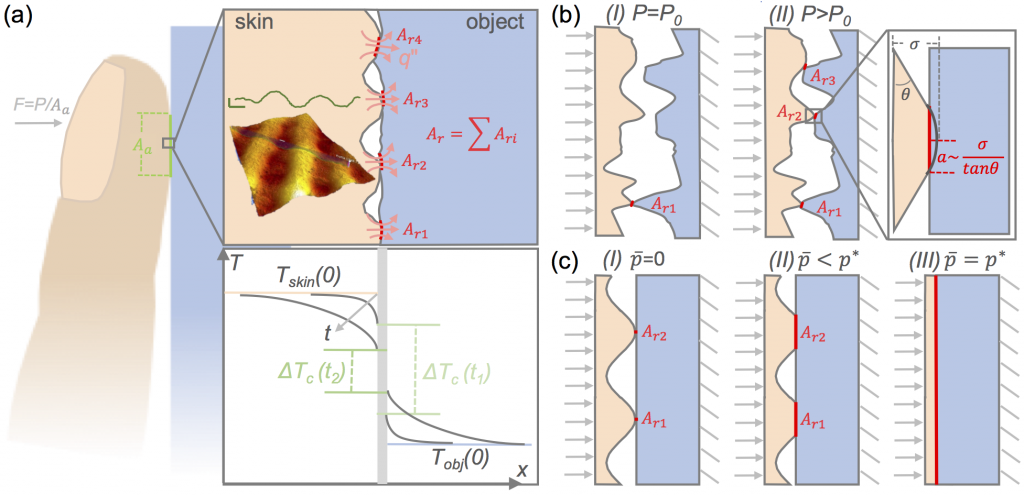
Heat conduction during direct skin contact
Understanding of heat transfer during skin contact with cooler or hotter objects is important for design of portable electronics, thermal displays, artificial hands, haptic devices, and wearable thermal systems as well as for setting safety standards in a variety of occupational settings. In addition, understanding of temperature impacts skin friction could aid the design of cooling devices for minimizing pressure ulcer formation.
Representative publications:
Valenza, A., Rykaczewski, K., Martinez, D.M., Bianco, A., Caggaiari, S., Worsley, P.R., and Filingeri, D.* , Thermal Modulation of Skin Friction at the Fingertip, Journal of the Mechanical Behavior of Biomedical Materials, (2023).

Rykaczewski, K.,* Dhanote, T. Analysis of Thermocouple-based Finger Contact Temperature Measurements , Journal of Thermal Biology, (2022).

Rykaczewski, K.* Modeling of Thermal Contact Resistance at Finger-Object Interface Temperature, 6 (1), 85-95, (2019).