Cool future “fashion” for a hot planet
We are developing novel outdoor testing protocols and new designs that optimize current performance and safety apparel, and thermally and mechanically supporting wearables. The development of such high performance, yet ergonomic, functional garments is not only important for current medical, military, and other specialized applications, but also for adaptation of broader population to future weather patterns.
New outdoor apparel testing protocols to quantify performance in realistic hot conditions
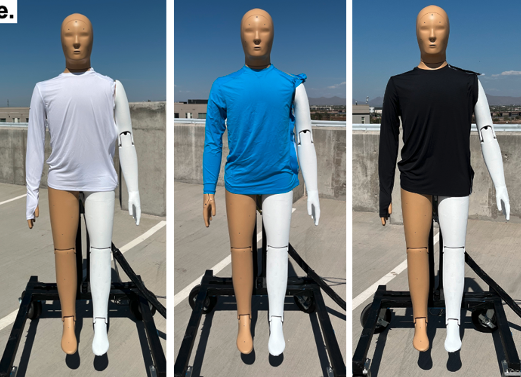
While there are numerous commercially available garments with a cooling functionality marketed for use in hot weather, there is a lack of systematic test quantifying the apparel performance in realistic outdoor conditions. To this end, we are developing new testing protocols utilizing the outdoor thermal manikin ANDI in the Arizona heat.
Representative publications:
Sadeghi, K., Viswanathan, S., Joshi, A., Bartels, L., Wereski, S., Jose, C.T., Mihaleva, G., Abdullah, M., Middel, A. and Rykaczewski, K.,* Resolving shortwave and longwave irradiation distributions across the human body in outdoor built environments, Building and Environment, (2025).
Improving personal cooling garments
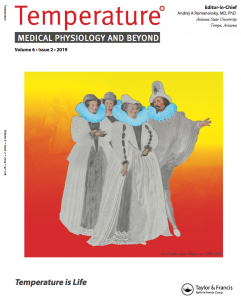
“Deadly heat waves: it’s only getting worse”, a headline from summer of 2019, succinctly summarizes recent weather and predictions on its future patterns. According to World Metrological Organization, the last couple of years have been the hottest on record and the average global temperature has increased by about 1.2°C since the industrial revolution. Disturbingly, this deceitfully mild increase is mainly due to longer periods of extremely hot weather. While there are uncertainties in climate change prediction, the consensus is that frequency and severity of such heat waves will increase significantly and will do so sooner than previously thought. Regrettably, significant warming will likely occur even if current prevention efforts are intensified. Consequently, those of us living in already hot places should begin thinking how our own, as well as future generations’, lifestyles will have to change in response to rising temperatures. In a recent editorial I argued that our social adaptation will have to involve the broad use of personal cooling garments. In our research we are trying to improve on currently existing cooling garments and are also contemplating on what the “cool future fashion” might look like. Read the free editorial here (Rykaczewski, Temperature, 2019).
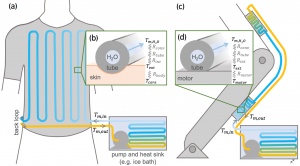
As part of our project sponsored by National Science Foundation on soft heat exchangers, we applied the novel, soft thermally conductive materials that we are developing for microelectronics applications to provide transformational improvements to traditional liquid-cooled garments. We are studying effects of thermal and mechanical properties of these materials on cooling efficiency of such wearable heat exchangers as well as their use for thermal management of wearable electronics and high power robotics. In addition, we are also starting to explore improvements that could be made to cooling garments that rely on water evaporation.
Representative publications:
Rykaczewski, K.* Cool Future Fashion: Personal Cooling as Part of Social Adaptation to Hotter Climate Temperature, (2019). (invited editorial)
Rykaczewski, K.* Rational Design of Wind and Sun Shaded Evaporative Cooling Vests for Enhanced Personal Cooling in Hot and Dry Climates Applied Thermal Engineering, 171, 115122, (2020).

Kotagama, P., Phadnis, A., Manning, K.C., and Rykaczewski, K.* Rational Design of Soft, Thermally Conductive Composite Liquid‐Cooled Tubes for Enhanced Personal, Robotics, and Wearable Electronics Cooling Advanced Materials Technologies, (2019).
Thermophysiological aspects and personal “cooling” applications of wearable robotics
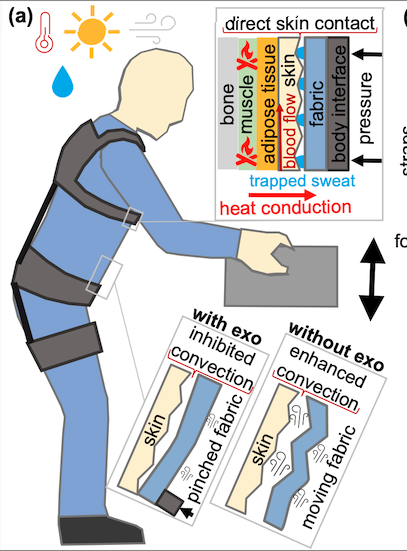
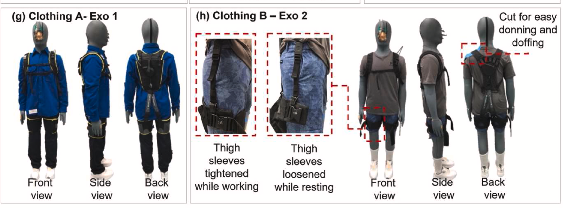
Technological advancements in the last two decades have enabled development of a variety of mechanically supporting wearable robots (i.e. exosuits and exoskeletons) that are transitioning to practice in medical and industrial settings. The feedback from industry and recent controlled studies is highlighting thermal discomfort as a major reason for the disuse of the devices and a substantial barrier to their long-term adoption. Furthermore, a brief overview of the devices and their intended applications reveals that many of the potential users are likely to face thermal comfort issues because of either high exertion or medically related high heat sensitivity. We focus on understanding the underlying thermal physiological mechanisms, developing potential solutions and a thermal manikin based platform for systematically measuring heat transfer inhibition caused by wearing of an exoskeleton. Lastly, we are also exploring the potential to reduce worker thermal strain and dehydration in warm-to-hot conditions via substantial metabolic rate reduction provided by exosuits.
Representative publications:
Joshi, A., Bartels, L., Viswanathan, S., Martinez, D., Sadeghi, K., Jaiswal, A. K., Collins, D., and Rykaczewski, K.,*Evaluation of Thermal Properties and Thermoregulatory Impacts of Lower Back Exosuit using Thermal Manikin, International Journal of Industrial Ergonomics, (2023).

Rykaczewski, K.,* Thermophysiological aspects of wearable robotics: Challenges and opportunities (Priority Review), Temperature, (2023).